

Sound Terrorists: Dadabots
A duo formed at Berklee College of Music built a band that didn't play instruments: they trained an artificial intelligence on hours of math rock and metal until it could generate its own raw music

(Article originally published Friday, September 3, 2021, recovered thanks to Internetarchive.org)
Written by Innervoid
Why have you done this?
Mischief.
Mischief (mĭs′chĭf): mischief
Behavior that causes annoyance or trouble.
Harm, destruction, or injury caused by a specific person or thing.
The answer is short, blunt, and can even give you chills if suspicion happens to be on duty that day. Maybe a single word holds more meaning than several paragraphs could ever unpack. The suspicion that they’d waited years for that question just to deliver such a precise answer clashes with the equally valid suspicion that such a surgical line might just be a lucky guess. Maybe they’re a couple of lunatics fooling around with a tool that could just as easily wreck a core piece of human culture — or maybe they’re secretly geniuses who, like Kasparov, can see several moves ahead of the play. Let’s get into it.
First pump the brakes: if, like me, you don’t really get what Deep Learning, Big Data, Machine Learning and all that are, we suggest this video to get up to speed
Dadabots is a band — except all of their music is made by Artificial Intelligence. Throughout the article we’ve left links for context, so you can soak yourself in what these people are doing. (*) Part (only part) of the text in this piece is transcribed from an “interview” with Dadabots on their official site. (We’d rather do it this way — give credit where it’s due instead of just making stuff up.)
“We started this band at Berklee, but now we make them look bad by association”
The first line of the tangled code that is Dadabots gets written at the Berklee College of Music, when in 2012 CJ Carrmeets Zack Zukowski and they form a [hackathon] team at the MIT Music Hack Day. Driven by the urge to make sense of the half-baked nonsense that is machine-made art, they decide to announce their goal: take down Soundcloud, building an army of remix bots to crawl the site hunting for music to remix and post hundreds of songs an hour. When Soundcloud bans them, the duo just keeps finding new ways to mess with the service. That’s how the project starts.
When software capable of so-called image style transfer came along, they were floored watching photographs morph into Impressionist oil paintings, and they clocked the potential of artificial neural networks. The pair had already been digging into ways to model musical styles and generate music with a particular timbre, and it turned out deep learning was the tool they’d been looking for.
Screenshot of website: “No instruments are played”
What sets this apart from other AI music projects is the SampleRNN model, which generates raw audio using a hierarchical learning/production structure. This model is trained to generate sound sequences — and in Dadabots’ case, the sounds came from math and metal bands. As it listens, the bot tries to guess the next fraction of a millisecond, a game it plays out millions of times over days. After this training, it’s asked to make its own music.
The whole sound-production process runs unsupervised — no music theory knowledge or application, no MIDI input, just raw audio.
Why? Because what Dadabots is after isn’t tonal precision in the MIDI sense, or melodic/harmonic development, but timbre — the sound that makes a style or an artist recognizable. This kind of analysis has only recently become available to mere mortals, and it’s far more complex than what came before it.
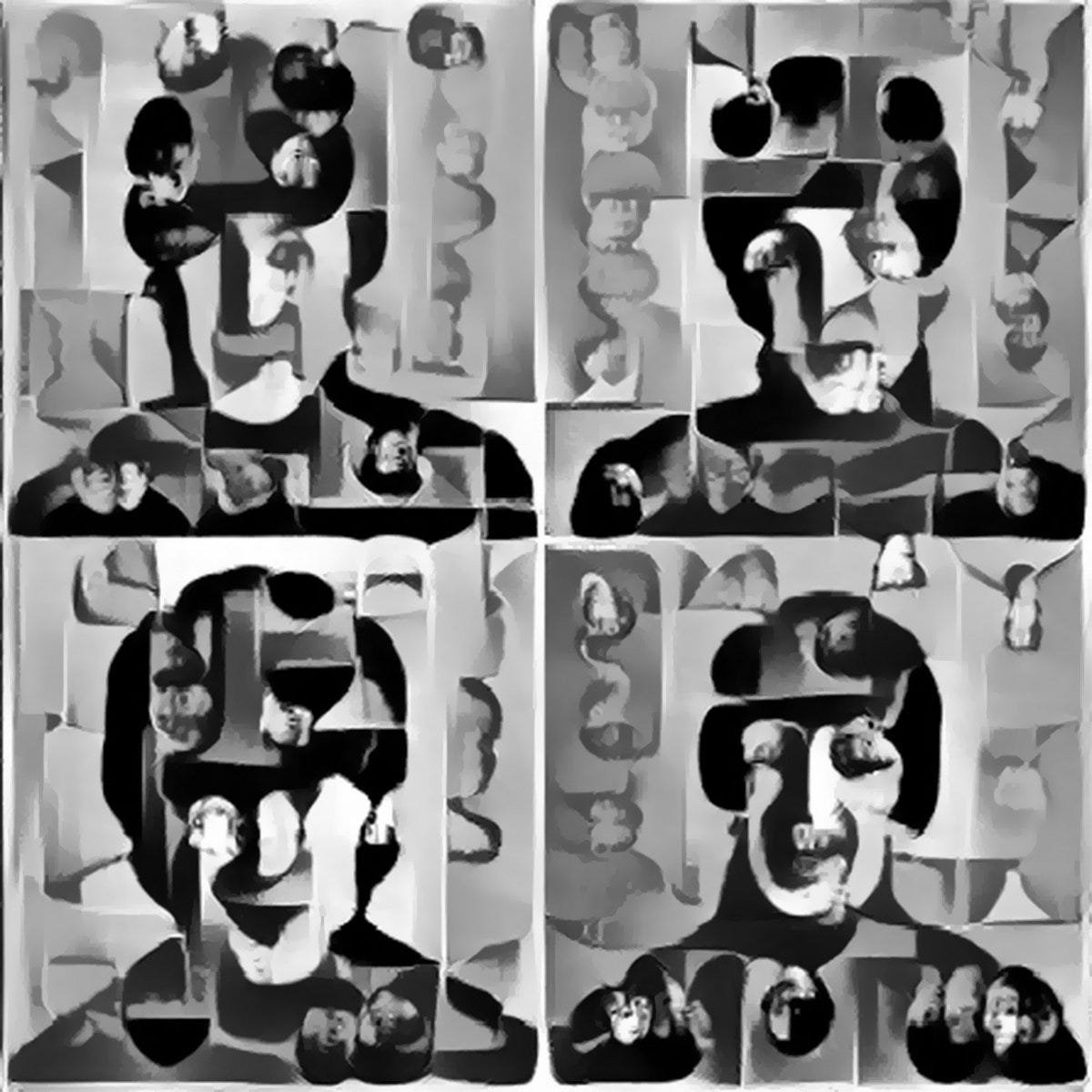
Screenshot of website: “Deep Beatles” on this album you can clearly hear the different stages of how the IA world the sound
MY recommendation: Evolution 12 (Iteration 35699)
Every raw audio file holds 44,100 samples of analog signal per second — gigantic sequences that need pretty heavy hardware and far more complex, smarter algorithms to analyze.
Since its learning method involves picking up progressively longer patterns, the AI first learns a small-scale pattern (a snare hit, the timbre of a scream, say), then a longer one (a guitar riff), then a longer one still (a steady tempo). The more it trains, the longer the patterns it spits out — but the job isn’t just to let the algorithm run flat out: the more it trains, the more it memorizes and just replicates what it’s memorized, so the most interesting results/sounds sit in a middle stretch.
This way the bot dumps out about 10 hours of samples that need sorting and combing through, so the Dadabots team built another tool just for that job. What’s left is picking the samples you like and arranging them for human consumption.
The band compares tuning and testing the model’s hyperparameters to brewing craft beer: “How much barley/how much sugar do you need?“; which can be read as: “What’s the learning rate? How many levels in the hierarchy?“ If something goes wrong, you only find out at the end of the road, where the result can be white noise, silence, or close to nothing.
CJ and Zack do all of it themselves — write the code, read arXiv (a free, open-access archive of academic papers in physics, math, computer science, electrical engineering, and more), handle the music production, the cover art, everything.
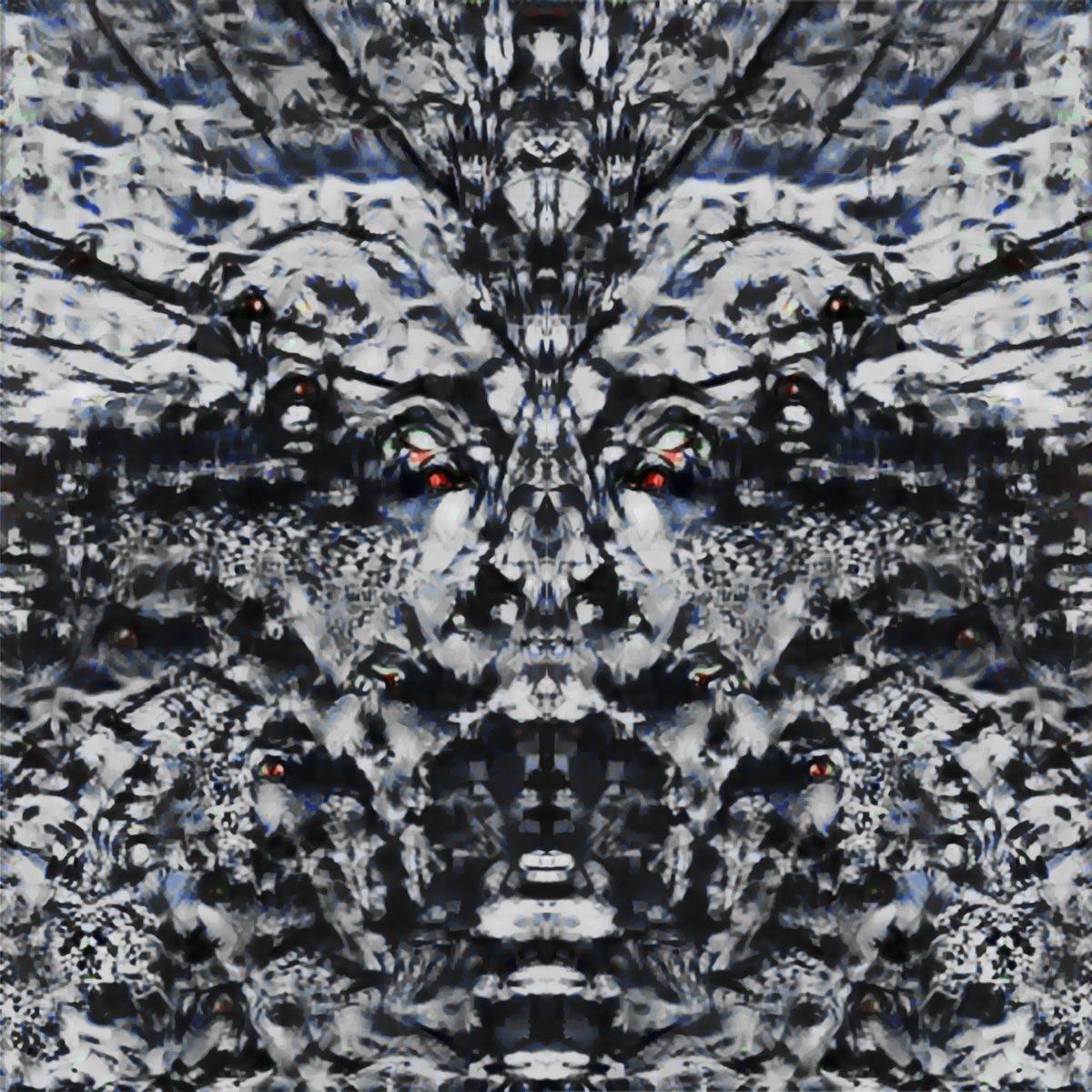
Screenshot of website. Cover of Inorganimate, an album generated after feeding the model Meshuggah’s Nothing
*”Our goal is human augmentation. Few people write music, but almost anyone has a musical aesthetic. Imagine a music production tool you just feed your musical influences, like a Furby. It starts generating new music. You sculpt it with your aesthetic. Imagine hearing everyone’s weird musical aesthetic coming out of their Furbys.
Really this is just meta-music — instead of playing the music, we’re playing the musician.“
Dehumanizational
Dadabots’ particular take on AI-made music puts the emphasis on assisting musicians in their creation, not replacing them.
Since tech culture is now baked into the world, and “going mainstream” matters for subcultures that go unrepresented and need a voice, there’s no real need for AI-generated music to become a hit; instead, its value as a tool for underground musicians is, according to Dadabots, enormous.
Unlike other AI music projects aimed squarely at the mainstream — which, the duo says, is a dead environment lacking any real substance, dead, static music — Dadabots sees its home in the underground, since that’s always been where people exploring and experimenting with music’s possibilities have lived.
Whether it’s math rock or black metal (both styles the duo loves) or any other style pushing and moving toward unknown territory, the search has to stay fresh. For Dadabots, recycling old sounds is like publishing scientific papers about the same old experiments. The point is keeping the music alive.

Screenshot of website: Coditany of Timeness: a collaboration with Krallice
A bot(ton) says it all
UK beatbox champion Reeps ONE was, at first, somewhat unsettled and a little scared hearing the essence of his own style distilled and replicated by a machine when he collaborated with Dadabots. Hearing what AI could do with his own voice (not to mention what’s possible with Deepfakes) felt strange.
That initial fear later turned into excitement once he treated the bot as a collaborator, since it produced strange beatbox patterns he’d never made before, pushing him to develop his own skills further.
According to Dadabots, if AI is designed in people’s favor, it’s a creative tool. Commercial groups seem to be pushed toward making pop music for market reasons, and academics toward generating classical music to stay within tradition. That’s a sign that the most likely outcome of full automation would be replacing professional creatives — especially any job built on formula: commercial composers, jingles, scores, and the like could land in that bucket.
That’s why we (Dadabots) say, “automate your job, don’t tell your boss.” Be the one running the machine.
The fact that the information is free to download on arXiv; that Linux, Tensorflow and other tools are open source — that shows that beyond open code, what’s needed even more is open, freely accessible understanding.
Yes, we live in a world where AI companies hold more power than most countries and are run by a tiny elite of people in the know — they will be (and already are) the ones setting the agenda, which is certainly not a participatory one.
Dadabots believes music and art are a great way to learn to play with AI, a way into understanding these tools, which is why they want to see more people forming bands with AI.
Screenshot of website: Dadabots official logo
Wrapping up
At the time this piece was written (*) the duo was prepping collaborations with bands like Lightning Bolt (give them a listen, they’re great), Artificial Brain, Krallice and more. They admit that after hearing so much computer-generated music, what surprises them more now is hearing what humans will do with it.
“Every extension of humanity, especially technological extensions, carries an amputation with it... cars amputated the need for a highly developed walking culture...“ -Marshall McLuhan.
Dadabots leaves us with this: no machine will ever give you the friends you make stumbling into a spontaneous beatbox jam on the street at 2 a.m.
Links
More from Dadabots
Outerhelios: 10 hours of AI-generated free jazz fed on the work of John Coltrane
Human Extinction Party: a death metal stream, fed on Cannibal Corpse
Lofi classic metal AI radio: an AI generating metal songs live, with shades of all sorts of things
Bonus
Turns out Dadabots entered “Can’t Play Instruments” in the second AI Song Contest, held this same year. The Wikipedia article has the full list of entrants, their works, and the results. Enjoy!
All images downloaded from the band’s site/Bandcamp.